
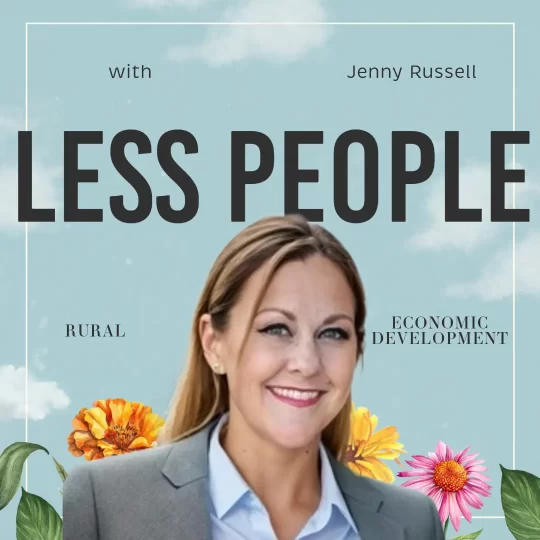
Welcome to another episode of Less People, I’m Jenny Russell. Growing up, I always wondered why my town just couldn’t go get rid of those ugly houses, or those ones that are nobody cares about, those ones that are empty and falling down. And as I got older, and as I got into this field of economic development, I started to learn the complexities of rural housing and realized you can’t just go do whatever you want.
So that’s really hard. It’s really hard as a community member who wants to see their town get better. It’s really hard as an economic development official that wants to make progress on housing because you cannot just go up and tear somebody’s house down.
And even at that, you can’t, it doesn’t come without a cost. Tearing something down is expensive, and then you can never rebuild it back up in the same style and the same quality of work. Because it’s too expensive to do so. I was speaking about this to the architect in our office, who is our rural architecture lead, about the Sears robot catalogs that used to be able to buy the home kits in.
So there’s a big beautiful painted lady house in Belleville that came shipped on a train, I’m sure. And then they put it together like a puzzle and it’s still standing today. And I was talking about why can’t you just do that? Why is that not a thing anymore? And one of the things we decided is that there’s used to be everybody was a skilled tradesman.
Everybody needed to know how to build. Everybody needed to be some sort of a carpenter, and they probably didn’t have a lot of indoor plumbing back in that day. So plumbers weren’t necessarily a thing.
Electricity might not have been a thing either, I don’t know. But everybody had some sort of handiness, had some hand, ability to be handy. And if most people are like me these days, not handy at all, I would not know the first thing, or it would not be quality, and it would probably fall down.
Coming in on a train with all the pieces, and I would never get it put together. So it’s just a very different world. You know, everything’s expensive, and you not only have to pay for the expensive materials, you also have to pay for somebody who actually is handy to be able to put it together in some way.
So darn, no houses coming in on trains. So what can we do as a town? It’s so frustrating. I know some towns that are, basically have property hoarders.
They have house hoarders. There’s been more than one community, more than one, one entire county, and he’s not, just wasn’t in the county, he was in the region. He just liked to go buy properties.
So, and he just sat on them and put stuff in them, stored stuff in them, made every single town that he went to look like junk. There’s another community in the county that I serve right now, and that whole county is taken over by one man, or this whole town is taken over by one man, and he owns downtown buildings, and he owns houses. And I’m sure back in the day, that was fine, but as he doesn’t take care of them, and as he gets more and more properties, it really prohibits people from being able to live there.
There’s nothing available, and there’s no places to build businesses in the downtown because there’s no buildings available. So, I know those are all really big pain points for people. Another issue that I see around towns is back in the, well, probably early 2010s, maybe, maybe even before that, probably, actually in the, when I first started in economic development, probably in the 2000s somewhere, we had, eBay was a kind of a new thing, and people started selling their buildings on eBay.
You know, we always have to look at new opportunities, make sure that they’re not something that we should be doing, and it’s not the answer to all of our problems and our questions, but there was quite a few eBay sales back in the day when it first came available for old schools, different things downtown, which seemed like a good idea if the builder, or the, excuse me, if the buyer was a good buyer and would take care of the building and put some business in there, and sometimes that did work out.
There’s been a couple of things, like my grade school building that I went to grade school in, in Glen Elder, was sold to someone who buys damaged goods basically, old, you know, truckloads of merchandise that was intended to go to a store and now ended up at this consignment type of a place. It’s sad to see my grade school go in there and see where my first grade classroom is, and now it’s, you know, piles and piles of boxes, but at least it’s being used.
Not everybody had that same experience of a good thing coming in. There’s lots of, another town I served, there’s people who have bought things on the internet thinking, you know, well, it’s cheaper than California. I can store something in Kansas for less than I can get a storage unit in California, so why not just store all of my things in these buildings, and then he kind of got a nasty hair about town and just decided that he was going to not fix anything, come into the dead of night and get stuff out and in, ignore all calls, all letters, and anything from the nuisance abatement people in the town, and just let the buildings fall in one by one by one.
He ended up by four corners, well, three corners and another little part of downtown in this town, and basically, one by one, the city has had to condemn them and tear them down at their own cost. Of course, you know, tack that on to the taxes, but if somebody doesn’t pay their taxes anyway, why is that a deterrent? So, one of the blocks ended up being one of those with adjoining walls, and every single building, they didn’t think they could salvage the rest of the buildings because of that common wall issue, tore the building down for $300,000. Well, and so people think, oh, just tear it down.
Well, it doesn’t have, it has a cost associated with it. It’s not free, and now they’ve got an empty lot that costs $300,000, and there’s nothing on it, and they still are dealing with one building that this man owns and will not do anything with. So, it’s just a very complicated issue.
People are wondering, you know, I think most of us and a lot of the outside world from rural areas has decided that rural areas are bad and not worthy, and nobody wants to live there, and the reality of it is, when you run the numbers, we couldn’t even go back to our 2010 population where I live because we have torn down enough houses and, you know, the new number of people per household has changed. We couldn’t fit those people back into the county if we wanted to because there’s nowhere to live, and we’re hundreds of houses short. We just came up with a program, a housing program, that the county puts the money into from a wind farm project and incentivizing grants to help people get over that construction material cost and build new homes and apartment buildings and townhouses, those type of things.
The program has been extremely successful, but, you know, we only built, I mean, we only built, we greatly built 20 houses in the past year and a half, which is more housing than I would say has been built in the county for the last 10 years, or maybe equal probably more, and it’s one of those things where it’s a great start.
We’re super happy with those who have built their own homes or builders who have decided to invest their money in building homes for people to live in and units for people to live in. 20 is just a drop in the bucket for the 137 that we need to build to make it back to that 2010 population. Even if we build 137 more as years go by and we continue to tear down houses and or have houses that are uninhabitable. That number just grows. So keeping up, it’s kind of like the lemmings, did you ever do that back in the 90s or, yeah. I guess it’s probably the 90s, that computer game where the little men climbed the hill and they just kept coming and coming and coming and coming. It’s like the lemmings, you’re never going to catch up.
It’s just, it’s really a, it’s a conundrum for sure, so, you know, as I said, when I was little, I thought rural housing was simple, just go tear down the ucky things and build something new, but again, you can’t do that. Even in the imminent domain of properties, you know, you can do that for economic development purposes. If there’s like a business or something that’s going to increase tax base, but that’s a hard process to get through too.
You have to often offer 200% of the value on something that you’ve already spent hundreds of thousands of dollars to tear down and see it reverts back to the property owner, even after the city has spent that much money to tear it down. Of course, it’s assessed on the taxes, but again, if that person doesn’t pay taxes and they do not care about it, then, I mean, it’s really tough to enforce. A lot of these smaller towns too, enforcement is a hard issue and it’s a hard topic.
Most of them don’t have nuisance abatement officers, so it falls upon the city council to do the work and if you’re in a small, small enough town and most of Kansas, you are going to be, most of rural America, you’re going to be in a small enough town where you know almost every single person.
So, what if it’s your brother whose property is a nuisance? It’s really tough as Joe on the city council to have to go tell your brother, hey, your property looks bad, clean it up. Oftentimes, then they also find and know the board in your own eye, so that, you know, they can go point out all the tires on your back deck, those type of things.
So, it gets really sticky. It gets really political and so a lot of these small towns, especially ones with not a lot of economies of scale or not a lot of population, just have stopped fighting the battle because there’s no way to enforce the codes that they do have and if they do have to enforce the codes, then they have to go do it themselves and that’s really tough and really, you know, it’s personal. It’s personal to criticize people’s property and it’s personal when people come back on you.
So, again, rural housing, it’s an interesting issue and most people, like I said, it’s not that your town is bad, it’s just probably that your infrastructure is old. We did a study and a large majority of our houses in our county were built before World War II.
So, everything ages and especially if it has not been kept up throughout the years, it’s gonna be. It’s gonna start looking bad and it’s going to be hard to control. When there’s no nuisance abatement officer on duty and there maybe are codes but they’re never enforced. You have to have a lot of pride in your community and you have to be, you have to have a special kind of community where people’s kind of keeping up with the Joneses hits in and you take care of your yard so your neighbor takes care of theirs.
I’ve also seen the opposite where you’ve got a neighbor across the street who has a beautiful yard that takes a lot of good care of theirs. A druggy has come in across the street because that house hasn’t been maintenance in the last 35 years. I mean those type of blight, that type of blight also, it just kind of gives permission on how to treat you.
We talked about this in previous episodes that you can, you kind of, by the way you keep things, teach people how you want to be treated so if your town is dressed up and cleaned up and ready to be a showcase. People don’t as often think oh this is a place I can put my trash next to the front of that building or I can write on this wall with graffiti.
They often tend to take your lead but if you’re not keeping up the town and you’re not enforcing any code, a lot of people will find that. I found that, you know, if you accept nuisance dogs in town then seven people move in with nuisance dogs, you know, that kind of thing so it’s just really interesting the dynamics of town, the code enforcement and all those things, how they influence rural housing. So food for thought on rural housing this week.
We will probably be delving more into rural housing conversations because it is a nationwide issue. A lot of people think that’s just a them issue, it’s just a rural issue but as you go throughout the whole entire nation, I’ve spoken about the Aspen Institute before and the cohort that I got to participate in the Greater Salina Community Foundation back in the mid-15-16, 2016-15-16 and it was really interesting to be in a room with rural people from throughout the United States, rural Iowa, Illinois, Bakersfield, California, Minnesota, all of us, all throughout the United States but we were all considered rural and like I said rural is very subjective. Are you Dollar General rural? Are you Walmart rural? No Dollar General at all rural? There are very different levels of rural.
So it’s amazing that we’re all kind of looped in the same thing but all of us ended up having very similar issues around child care and housing and of course, you know, other issues as well but child care and housing were the big ones and it’s amazing to me all throughout the United States that we all had those similar problems. So if you’re fighting this fight in your community, keep up the good work. It’s a hard job and people don’t realize that you can’t just go tear stuff down.
You can’t just go clean things up. You have to be able to go through the process and make sure that you’re doing everything right, guiding your eyes, crossing your T’s, doing what’s legal, then law, following the rules, all of those things when others don’t have to, when those property owners just seem to ignore the rules and ignore what you’re asking them to do and ignoring the nuisance abatement letter and the fine. So I appreciate you.
I hope that you feel that through this podcast and you keep up the standards, the good work and using things like land banks. If you haven’t figured out land bank, go read up on that. We do have a link to the rural land bank presentation that our good friend Julie Lyon did.
She’s now in Kingman County. She is a great resource, had done some great things with land banks when she was the mayor of Stafford, the city of Stafford in Kansas and like I said, keep up the good work in housing. It’s an important job.
It’s a valuable job if you keep after it and do what’s right and do keep those standards high because people cannot make sure your community enjoy it if you have no houses to live in. Alright, that’s my take on rural housing for this week. I hope you have a wonderful week and thank you for listening to Less People.
We’ll see you soon.