
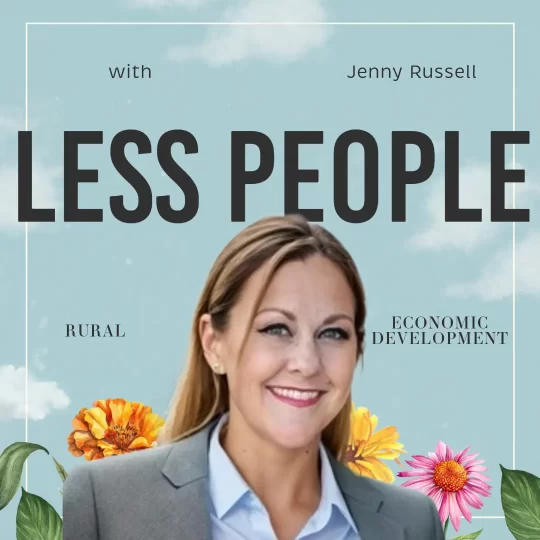
Welcome to another episode of Less People. I’m your host, Jenny Russell. Thank you for following and supporting Less People, the podcast about real economic development here in season one.
We are about to embark on season two of this show, but to help us, please give us a like and a comment and share our episodes, follow our episodes on YouTube, also on Spotify, and help us to grow our audience. Share this with people who might be interested in this content. It helps our podcast grow, and we hope you have enjoyed the first season of the show and we will be back with the second season.
So go back and re-listen to episodes and get caught up on what we’re working on, and then we hope to bring you new content in the coming season. So thanks again for listening. I thought I would give you a little bit more background on who I am.
I know that when we started this podcast, I talked about rural economic development issues and a little bit about my background, but what makes me qualified to talk about these issues? So I’m originally from Kansas. I’m a farm girl, a dry land farmer in Kansas, about an hour away from where I live now. I didn’t think that there was that much difference.
Never thought I’d have to differentiate dry land farming, but in the area that we are in now, we are in a very tall, long, and skinny irrigation district, and those guys doing irrigated farming, it’s a very different world. But I’ll come back to that in a little bit. I grew up on a farm.
My dad was a dry land wheat farmer, and he also had milo. Now, as the years have progressed, he’s had soybeans and sunflowers and those type of things, but he never did have those growing up. We definitely had wheat and milo, and those were our main crops, but he also had cattle.
My mom was a science teacher and a high school science teacher. She got to stay home with us through the years of the 1980s farm crisis in Kansas and the Midwest. That was a big deal. The resilience of my parents that we were raised in that era with one income. It was a solely farm income, but definitely shaped who I am today.
Glen Elder is a town of about 400 people, and it was founded in the late 1800s, 1871. It’s kind of interesting. We’ve had a lot of different movies come out, documentaries and movies come out recently about Kansas.
Of course, you think of Laura Ingalls Wilder and her books from Little House on the Prairie. Yes, that is kind of what Kansas is like. But Sod and Stubble, it’s a new documentary, small movie. It has Bailey Chase in it, and it was actually filmed in nearby Downs, Kansas.
As we watched that movie with my kids a couple of weeks ago in the theater. I thought, you know, I don’t really think about why people are like they are in Kansas. We’re very resilient people. We’re very can-do people, and we don’t usually use a lot of government handouts.
We kind of have the attitude that we’re going to do it ourselves. And I think most people in the Midwest and rural areas are like this. But you see how those people, what they had to deal with when they came out here by covered wagon.
I do think when I get to eastern Colorado sometimes and I look up at the mountains. I think, wow, what would you have thought you were driving a covered wagon through here? You know, going across the plains is one thing in a covered wagon. I can’t imagine how bumpy it was and just different things. Different hazards that you would have encountered during that time. But to get to the mountains and think, how am I going to get this covered wagon over this mountain? It had to be daunting.
But as Paul Ingalls in those books from Little House on the Prairie was, he’s very adventurous. Probably Ma was a very tolerant person. I think that as I have grown up and gotten married, I think, oh, Paul Ingalls would have been a pain.
But he definitely had that pioneer spirit. He moved a lot, and he moved his family a lot, asked a lot of them. I’m sure it was a very exciting time, but it was a very, I would say, pretty scary, too, to go out on a covered wagon with your family, with your babies, and come across all this terrain.
But Sod and Stubble definitely highlighted that. They came in, in the movie, they came from like eastern Kansas, northeastern Kansas on a covered wagon. But I’m sure that still would have been quite a drive.
I mean, in a car, I would say that it’s situated in Downs, Kansas, and from Downs to Holton, I believe, is where that was located. It’s like three hours by car. So still would have been quite a trek in a covered wagon.
But the things that they faced, you know, the drought and the harsh climate of Kansas, it’s not for the faint of heart. That’s kind of what shapes our people in the Plains areas, as the culture and the weather, you know, are very dependent upon the weather. So extreme hot, extreme cold, and Indians back then, in Indian territory, they were coming right into that.
And then, of course, the sickness and how, you know, I was thinking about how that shapes us as well. It was very much reliant on faith. You know, they didn’t have a lot of doctors out in the Plains and Sod and Stubble days.
They had to rely on hearing, you know, take this elixir and say a prayer and hope they get better. But just, you know, my kids came away from Sod and Stubble, the movie, as this was sad. I’m like, but it’s probably pretty accurate as to how life was back then.
They lost a baby, probably lost a lot of people in childbirth. As we know, childbirth is still dangerous. And they lost friends and neighbors.
The main character in Sod and Stubble, Henry Eyes, was his name, and he was an actual person. He died really 45 years before his wife passed, and she lived into the 1940s. It just really kind of made me think about where I’m from and kind of what shaped who we are.
But yes, I grew up in Glen Elder. I always liked the town of Glen Elder, and I would say the place I live now is very similar. I graduated from a class of 21 people, and we were talking about this the other day at Community Coffee.
Somebody said they had been in Omaha, Nebraska, and so they talked about their hometown, and that they had graduated with 27 in their class. It’s really hard for people to fathom that, but I wouldn’t change how I grew up in terms of how it made me who I am. The school, definitely, it was very diverse going into college.
I knew lots of different things: could play some basketball, sing some songs in choir, play the flute, run some track. I could, you know, do all of the different things: I was in theater, all of the arts, and I was also in all of the sports. What I noticed when I went to college was that many people had, maybe they were really good at one thing.
They were really good at, you know, choir, but they had no ability to tell you any of the rules of football. So I realized how diverse and interesting some of our rural area people can be because we do have the ability to have all these different experiences in all of these different things. My interest coming out of high school was definitely communications, and I did keep that.
Amazingly, I did not change a major. I chose Bethany College. It’s a small college in Lindsborg, Kansas, and it’s a Swedish-based college, which came back to suit me well, I guess, in later life.
I started out in communications and added business eventually because I was like, what do you do with a communications degree? I wasn’t even sure. You know, so I saw a poster on one of my professor’s doors that said, here’s everything you can do with a communications degree. It was everything from being a radio announcer to being a pastor to being in newspapers.
I mean, it’s just being an English professor. There was just so many different things you could do with a communications degree that I decided I needed to narrow that down. I added business in there, and so I graduated with a dual major in communications and business.
Marketing was the focus, and that’s kind of where I stayed. Never really strayed from my passions. I definitely had that down, which was pretty amazing. I think, for a senior in high school to kind of know the direction you want to go.
What a hard thing to do coming out, trying to figure out what you’re going to do. The reason I say I talked about in an earlier episode about my senior thesis was on economic development for my hometown of Kansas. That must have instilled a passion in me because one of my people in the class that I was presenting to said, why save it if it’s dying? And that really ignited a fire in my belly about saving and helping rural areas.
So that’s the work that I’m in now. But I ended up, my second job out of college was an economic development job in Republic County, Kansas. And I did that job for about a year and a half.
In the previous three episodes, I spoke about our inspirations in terms of people who have influenced what JenRus Freelance does. But there’s also a business. One of the businesses that really shaped what we do, I left economic development. The only way I was going to leave economic development here, because that was my passion, was if I got a job at Brush Art Corporation in Downs.
And I did get offered that job. And so we ended up moving after a year and a half. I ended up moving after a year and a half to that job at Brush Art Corporation in Downs.
If you don’t know about Brush Art Corporation, it is an advertising and marketing agency. It’s located in Downs, Kansas, which now has a population of less than 800 people. But they do great work, and they compete very well with Los Angeles firms and New York firms and different firms around the nation.
But those New York and Los Angeles firms cannot measure up in the fact that living in Downs, Kansas, Brush Art doesn’t have the same overhead as you do in a large city with expenses and the payments, salaries, and different things that people need to be able to afford a city life. So the work that they did was nationwide and international marketing work for different entities. I learned a lot there and stayed there for six years.
And that’s where I married my husband, was in Downs. And after we had kids, it was a little less appealing to be gone for web sales across the nation and different things. So I definitely wanted to have some more flexibility to be with my kids.
And Brush Art didn’t offer remote work, but they did offer the fact that if I wanted to go out on my own, they would send me some social media marketing and web stuff for the first year to kind of get me started. And then I could go out on my own. So I did work for them just as a freelance person for about a year.
And then I went out on my own and started my company actually out of my living room in Downs. So our ultimate goal, my husband and I, was to get back to Courtland, which is his hometown, but no place really compared. So we took the chance of liking something, you know, 95% in Downs, see if we could like it 98% somewhere else.
And the chance really paid off. Now we’re located in Courtland, Kansas, which again, I talked about the first of this podcast episode. It is an irrigation district is what this is in.
So they are, I don’t know if you call them wetland farmers, is that what you call them? So I came from a dry land farming background. Wasn’t a super great farm girl, I will admit. Not real great with getting dirty.
That’s not one of my passions. I do not like to pee outside. If you ever met me, I’m not one of those people.
And I definitely like my modern conveniences. I’m very proud to be a farm girl, not a great farm girl, but I’m a much better farm wife. My husband comes from an irrigated farm background and cattle operation.
And he’s asked me nicely and he’s cute. So I do lots of things for him that my dad was always surprised that my husband can get me to do and my dad can never get me to do. So definitely have an appreciation for agriculture and for farmers.
But Courtland is just a bit smaller than my hometown of Glen Elder. It’s about an hour away and it was actually founded almost since the 1885. So it was almost 15 years older and something I noticed a couple of years ago.
So everybody was having their, I think it was 125th, 125th, I think, anniversaries of their towns. And I was like, oh, okay. I wonder when Courtland’s is.
And it’s like 25 years later that all the rest of the surrounding communities, even the next town over, which is six miles, that was celebrated a few years ago. It was 125th and Courtland’s is still not celebrated theirs. So I looked that up and they’re like, well, yeah, I mean the river.
So the Republican river was there for fairly wide. And again, if you’re in a covered wagon or if you’re trying to travel somewhere and a big river’s in your way, you’re definitely probably not going to cross as easily. The river was there for one.
And then for two, this area, I live about two and a half miles from the Pawnee Indian Village here in Kansas. If you’ve not been to Pawnee Indian Village, you should go. It’s actually built.
The building is built around a lodge, a Pawnee Indian lodge where they used to live. And you can actually see the floor and all of the remnants of that lodge. And then the indentations in the yard of all the different lodges of the Pawnee Indians.
There we go. But we always joke that, and it’s probably true, on the other side of Scandia across the river was all the Indians. So people didn’t want to take their lives into their own hands.
So Courtland was developed 25 years later than Scandia was. But what I do love about where I live now is that it is very diverse in terms of who settled this area. And they still are very culturally, like, celebrate the cultural traditions of where they came from.
So Cuba, which is on the far eastern side of the county that I’m in, it is Czechoslovakian or Bohemian. And they still celebrate a lot of Czech traditions over there. And I’m actually German.
My background is my family came from German ancestry. But I say I’m an equal opportunist when it comes to cultural celebration. So I love to celebrate with the Cuba people over there.
Most of the people over on the west side of the county are Swedish. There’s like a French settlement in Clyde, Kansas. So there’s lots of different ancestries that came around to form this place.
So again, we saw Sod and Stubble a couple weekends ago. And that talked about the Prairie Pioneer story of a couple that came and settled in the Downs area. There’s actually a book that is written about that.
The movie was based on that book. Then the other night, we got to go see the Minersville documentary. It was sponsored by Communities Kansas.
I had a little bit of a part in trying to market that and help that get produced. It’s about a little town in the southeast portion of Republic County, right on the Cloud County line in Kansas. They started mining coal. During those times when it was rough. All these people had come from eastern United States. Come out here with that pioneer spirit with their families. There wasn’t a lot of trees to burn for firewood.
And as part of that documentary, they talked about, you know, it’s always hard to keep warm, always hard to get warm, and always hard to keep warm. As a little kid, this guy was recalling that. So when they found this line of coal in the ground, you know, that was what sustained them.
That is what made it possible for them to stay here in the harsh winters of when they were arriving. So this coal didn’t end up being extremely good coal. It was very low quality.
It didn’t burn that cleanly and or that well and was pretty hard work getting it out of the ground. But it’s kind of cool that we had some coal mining in northern Kansas.
There we go, new fact for you. So if you get the chance when Minersville is released, you should definitely go look at that. But again, amazing the wherewithal of the people who came before to get that done.
But they talked about, you know, there was Welsh people from and there was Swedish people, and there was French people, they all kind of came and worked together in Minersville. And if you couldn’t work together out here, you probably were not going to survive very long on your own. You needed your neighbors, you needed their support.
So anyway, I feel like that’s Pioneer Spirit and that spirit of needing each other is definitely still in a lot of rural areas and definitely still here in Republic County. And the Swedish, the Swedish comes back again because I went to a Swedish college in Lindsborg, Kansas. I observed their Swedish ancestry and Bethany College was started by Swedes.
I ended up marrying my husband and his mom and his two uncles went to, were from Lindsborg and they went to Bethany College. Originally went to Bethany College and only knew about Bethany College because of my sister who had found it first and she was two years older than me in school. She chose Bethany College, then I chose Bethany College as well.
Ended up being lots of ties there and there are a lot of Swedish ancestry people that did go to Bethany College that still live and work up here in this area. So the banker in our hometown bank had, his mother had moved to Lindsborg when his parents divorced. And so he has a lot of ties in Lindsborg, a lot of people I know and small Kansas world.
I always say that it’s amazing how we can know pretty much anybody. If we don’t know them, we know somebody they know. Again, a very small state thing.
And I love that about living in the rural area and living in Kansas is that we do have those connections and those people connections. I always say you move here for the people, not exactly for the amenities, but the people are what makes this state great and the people are what make where I live great in Republic County. So I just wanted to give you a little bit more background.
Like I said, I started my marketing company after my career at Brush Art for six years, which was a great experience in the marketing world. And now I’ve been doing economic development and community marketing since 2008. So been doing it a little while and we’ve had some fun projects and great experiences.
And just, we just really love helping people. We’re into all kinds of different things, not only community marketing, but we also have this traditional marketing realm of websites and social media marketing and print web, you know, print work. We also have a full apparel shop.
So, and that is called a little hometown shirt. So when I give a shout out to a little hometown shirt, we can make any of your apparel needs, hats, shirts, different things for different events, different things for your company, then different things for your organization or your events in your communities. Go check that out at alittlehometownshirt.com. Shout out to us if you need any marketing help for your community or for your business.
We have jenrusfreelance.com, which is our marketing realm. And then we have 314 Graphic Design, which is our graphic design web and social media. So we also have a full-time videographer and photographer, we can do pretty much any job there as well.
I hope you enjoyed this deeper dive into who I am and why I might be talking to you about this subject of rural economic development. And again, I’m Jenny Russell and this is the podcast, Less People. I hope you’ve enjoyed today’s episode.